
8/2026 Retirement Success
Welcome to the August edition of my Market Newsletter. I keep finding there’s an abundance of noise and confusion in the financial markets, and most Americans don’t know how to cut through the noise and get the data they are really looking for to make informed decisions. Because of this, I’ve created this newsletter, where each month I put together a summary of thinking’s to help educate long-term decisions. With that said, let’s get to it!
Disclaimer: Because of the increased regulation and compliance in the financial industry, I want to start with saying everything in this newsletter is based on my opinion, is not predictive in any way. Also, I used AI to assist in rewriting my newsletter to reduce grammatical errors and to improve syntax.
As we navigate the ever-changing financial headlines, I find it invaluable to pull back from the daily noise and ground ourselves in the foundational principles of long-term investing. This month, I want to explore three critical themes that affect every wealth plan: the mechanics of retirement cash flows, the realities of long-term inflation versus compounding, and the discipline required to maintain true diversification.
1. Why Timing Matters: Understanding Sequence of Return Risk
When transition planning shifts from building wealth (accumulation) to spending wealth (decumulation), the calculus of portfolio design fundamentally changes.
Many investors assume that as long as a portfolio achieves a healthy long-term average return, the ride along the way doesn't matter. Unfortunately, in retirement, the order in which returns occur has a disproportional impact on long-term success.
Consider two investors who achieve the exact same average annual return over 20 years.
Investor A experiences strong, positive market returns in the first few years of retirement.
Investor B encounters a sharp market downturn immediately after retiring.
Even if the average returns over two decades are identical, Investor B faces a structural headwind known as Sequence of Return Risk. When you draw regular income from an asset base that is experiencing early losses, you are forced to sell depreciated shares to satisfy living expenses. This permanently shrinks your baseline capital—leaving fewer shares in the portfolio to compound when the market inevitably recovers.
Portfolios will never follow simple textbook "rules of thumb" or rigid, automated rules. Because returns are entirely unpredictable for any short-term period, investment strategies cannot be one-size-fits-all. A portfolio must be purposefully constructed around your specific income needs, cash-flow timelines, and personalized long-term goals—insulating short-term liquidity needs so market downturns don't jeopardize your lifetime distribution plan.
This is one of many reasons why it is critically important to update a retirement income plan through the years.
2. A 30-Year Perspective: Volatility Is Just Part of the Deal
To maintain discipline during turbulent periods, it helps to zoom out. Looking back 30 years to July 1996 gives us a striking visual of how capital grows alongside the relentless rise of everyday living costs:
The Cost of Living: In 1996, a U.S. postage stamp cost 23 cents. Today, that same stamp costs 82 cents—a 2.6x increase. Similarly, the Consumer Price Index (CPI) sat at 157 in 1996; today it stands around 334, more than doubling (2.1x increase).
Stock Dividends: Over that exact same 30-year span, S&P 500 dividends grew from $14.89 in 1996 to a 2026 estimate of roughly $83 per share—an increase of about 5.6x.
Stock Market Gains: The S&P 500 index itself rose from around 635 points in 1996 to roughly 7,500 today—an 11.8x increase. And you didn’t ask… but if you owned Gold back in 1996, 10k in Gold would be about 40k, that same 10k invested in the S&P 500 would be about 195k today.
30-Year Growth Comparison (1996 vs. Present):
Stamp Price [2.6x]CPI (Inflation) [2.1x]S&P 500 Divs [5.6x] S&P 500 Index [11.8x]The lesson? Owning equity in arguably great American and global businesses has historically been one of the most effective ways to compound purchasing power well past the rate of inflation.
However—and this is a critical "however"—it was never a smooth ride.
Over these past 30 years, the S&P 500 declined by roughly 20% or more on eight separate occasions. It weathered dot-com bubbles, financial crises, global pandemics, and rapid interest rate hikes. Volatility isn't a flaw in the financial system; it is simply part of the "deal" when investing in broad, liquid markets. And yes - I do anticipate many more declines like these in the future.
3. The Discipline of True Diversification
Speaking of broad market investing, I find it hard to overemphasize the importance of true, unglamorous diversification.
Market cycles constantly offer up seductive "hot trends" that tempt investors away from disciplined allocation. We see this cycle repeat like clockwork, just consider the past few years:
The Speculative Tech Boom: A few years ago, hyper-growth ETFs like ARKK were shooting the lights out, dominating financial news until peaking in 2021. Today, the fund remains down roughly 40% from those highs.
The Crypto All-In Craze: Around that same time, enthusiasm for cryptocurrency peaked. I recall a former client who decided to go "all-in" on crypto right at the absolute top of the market. While I sincerely hope his family is doing well, abandoning a structured plan for speculative concentration rarely ends smoothly.
The "S&P 500 Only" Fallacy: More recently, many argued that investors only needed to own large-cap U.S. stocks. Yet when you examine historical cycles, ignoring international equities and small-cap positions has repeatedly proven to be a short-sighted strategy when market leadership rotates.
The Recent AI Mania: Today, AI is the dominant headline. You may recall me mentioning a 24-year-old hedge fund manager a few months back. He launched an AI-focused fund, loaded the portfolio with leverage, and seemed on top of the world—until reality caught up. In a span of just 3 to 4 weeks, his fund's assets plummeted from $45 billion down to close to $10 billion. A stark, $35 billion reminder of how fast leveraged concentration unwinds. Article: here
The Moral of the Story
Diversification sounds easy on paper. But after close to 20 personal years in this industry, I can tell you firsthand that maintaining disciplined diversification in practice is remarkably hard. It requires the emotional fortitude to own asset classes that feel unexciting in the moment, while resisting the siren song of whatever asset class happens to be making headline news.
Looking back with hindsight, I am thrilled that we have never strayed from our core discipline for our clients. Portfolios built with purpose, patience, and broad allocation continue to be the ultimate beneficiaries.
Additional Data: Each month I get asked by clients what additional resources I’m looking at. Please hear me in stating I’m not trying to predict anything whatsoever, just some of the interesting data I’m watching.
47 Year Anniversary – Later this month in August, we’ll have the 47th anniversary of one of the most infamous investment articles ever written – “The Death of Equities”. I’ll encourage everyone to take 10 minutes and read what has transpired since. The article issued 47 years ago almost perfectly timed the market bottom and kicked off one of the greatest bull markets in history.
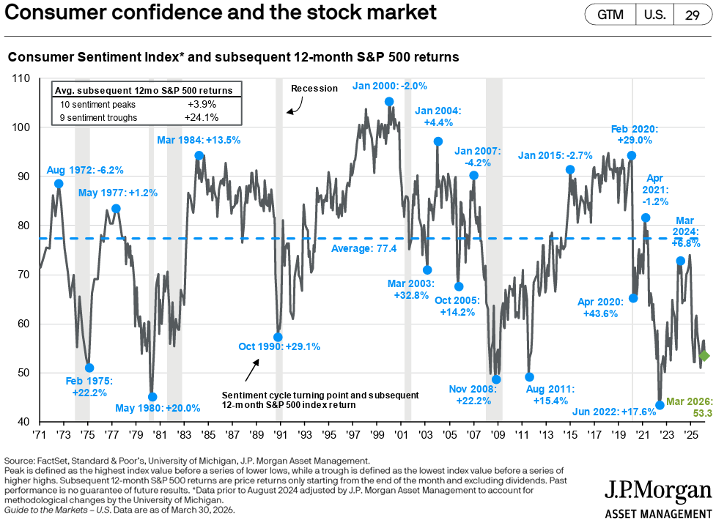
Did you know that today’s consumer sentiment is about as low it was it was during the Financial Recession? And historically, when sentiment is low, investment returns are high. Take a moment and review this chart from JP Morgan.
Breakeven Inflation Rate - 5-Year Breakeven inflation rate is now 2.31%. You better believe this is going to garner significant attention by the Federal Reserve and the incoming Fed President. I’m curious to see what happens in the next few months.
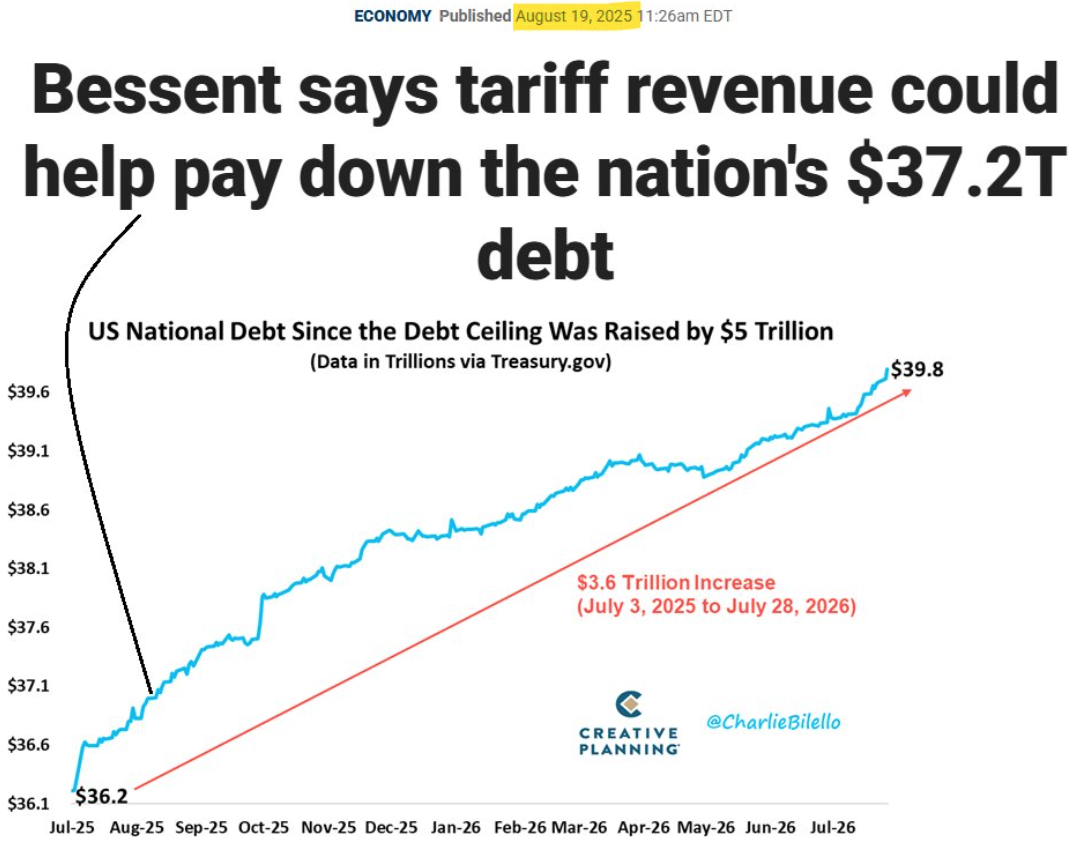
Debt Interest Payments – Most in this country would agree that the Federal Debt is just too high, but did you realize that the interest payments on this debt is now just over 1.2 trillion a year? What should we do about it? My guess is we should balance the government budget…. But no one is asking me. And… it’s disappointing to see this chart of what was said and what’s actually happened with Government debt.
Final Thoughts
Whether we are structuring cash flows to protect against sequence risk, enduring short-term market pullbacks, or tuning out the latest market fads, our focus remains squarely on what matters most: your long-term goals.
If you have any questions about your current allocation, retirement income strategy, or overall financial plan, please don't hesitate to reach out. We are always here to help.
As always, thank you for your trust. If you have any questions/concerns, please contact me. If you found this useful, please share with someone you care about.
-Dave
David Hobbs, CFP®
Wealth Advisor | Owner
Hobbs Wealth Management
Past performance may not be indicative of future results. Investing in securities involves risks, including the potential for loss of principal. There is no guarantee that any investment plan or strategy will be successful.
Standard & Poor’s 500 (S&P 500) - a market-cap weighted index composed of the common stocks of 500 leading companies in leading industries of the U.S. economy.
Russell 2000 – The index measures the performance of the small-cap segment of the US equity universe. It is a subset of the Russell 3000 and includes approximately 2000 of the smallest securities based on a combination of their market cap and current index membership.
MSCI ACWI ex USA – The index measures the performance of the large and mid-cap segments of the particular regions, excluding USA equity securities, including developed and emerging markets. It is free float-adjusted market-capitalization weighted.
Federal Funds Rate - refers to the target interest rate set by the Federal Open Market Committee (FOMC). This target is the rate at which commercial banks borrow and lend their excess reserves to each other overnight.
This report was prepared by Hobbs Wealth Management, a State registered investment adviser under the Investment Advisers Act of 1940. Registration as an investment adviser does not imply a certain level of skill or training. The oral and written communications of an adviser provide you with information about which you determine to hire or retain an adviser. Neither the information nor any opinion expressed it so be construed as solicitation to buy or sell a security of personalized investment, tax, or legal advice. For more information please visit: https://adviserinfo.sec.gov/ and search for our firm name.
This newsletter is prepared to provide a degree of insight into the analysis used by Hobbs Wealth Management to make investment decisions. It is not a complete description of all the factors used by Hobbs Wealth Management to make decisions on behalf of clients. The opinions included are not intended to be taken as fact but are Hobbs Wealth Management’s interpretation of the impact of external events on investments.
The information herein was obtained from various sources. Hobbs Wealth Management does not guarantee the accuracy or completeness of information provided by third parties. The information in this report is given as of the date indicated and is believed to be reliable. Hobbs Wealth Management assumes no obligation to update this information, or to advise on further developments relating to it.
This article contains external links directing you to a third-party website. Although we have reviewed the website prior to creating the link, we are not responsible for the content of the site.
An index is an unmanaged portfolio of specific securities, the performance of which is often used as a benchmark in judging the relative performance of certain asset classes. Investors cannot invest directly in an index. An index does not charge management fees or brokerage expenses, and no such fees or expenses were deducted from the performance shown.
The mention of specific securities and sectors illustrates the application of our investment approach only and is not to be considered a recommendation. The specific securities identified and described herein do not represent all of the securities purchased or sold for the portfolio, and it should not be assumed that investment in these securities was or will be profitable. There is no assurance that the securities purchased remain in the portfolio, or that securities sold have not been repurchased. For a complete list of holdings, please contact your portfolio advisor.
Hobbs Wealth Management may discuss and display charts, graphs, formulas, stock and sector picks which are not intended to be used by themselves to determine which securities to buy or sell, or when to buy or sell them. This specific information is limited and should not be used on their own to make investment decisions. This information is offered as educational only.