
9/2026 Strong Market Strategy
Disclaimer: Because of the increased regulation and compliance in the financial industry, I want to start with saying everything in this newsletter is based on my opinion and is not predictive in any way. Also – I used AI to assist in rewriting my newsletter to reduce grammatical errors and to improve syntax.
Full written text listed below
It hasn’t escaped notice that the U.S. stock market has put on quite a performance since the bottom of the Financial Recession. Created from record corporate earnings, the S&P 500 reached new all-time highs again just this past month. Wall Street consensus forecasts even higher earnings ahead, with major investment firms projecting continued gains through the end of the year and beyond.
To put some hard numbers on it:
March 9, 2009: The S&P 500 bottomed out after the Global Financial Crisis at 677.
Today: The index stands above 7,700—growing more than 11 times over the past 17 years.
If you had $100,000 remaining in a broad index fund at the bottom of that 2007–2009 downturn and simply stayed the course while reinvesting your dividends, that balance would have grown to approximately $1,350,000 today—compounding at over 16% annually.
As Charlie Munger famously remarked, "The first rule of compounding is to never interrupt it unnecessarily."
The single most effective action an investor can take during a strong market is to get out of the way and let principled consistency do its work.
The Danger of "Getting Too Cute" in a Bull Market
When markets march upward for years, excitement naturally follows. Headlines constantly declare new eras of endless technological growth, then these articles will try and “sell” the reader on a new-fangled investment idea with no historical track record.
When everyone around us seems to be making easy money, a very human temptation creeps in: we take our eye off the ball. We start wanting to get "too cute" with our portfolios—chasing individual trends, over-allocating to hot sectors, or taking risks our families simply cannot afford to take.
We’ve seen the warning signs in the margins—parabolic runs in speculative assets followed by swift drops, or overly leveraged funds making headlines before falling apart.
When you feel the urge to chase the latest market fad, take a step back. Betting your family’s financial security on a trend is one of the quickest ways to interrupt compounding unnecessarily.
Normal Market Drops vs. Emotional Reactions
While chasing trends is dangerous, the single greatest risk to your long-term wealth isn’t a market correction—it’s panicking out at the wrong time.
History offers us a consistent pattern worth keeping in mind:

It has been about four years since the market decline of 2022. Pointing this out isn't predicting an imminent crash—nobody has a working crystal ball—but market history shows us that temporary drawdowns of 20% or more are a completely normal part of long-term investing.
When a decline happens, two distinct emotional traps appear:
Fear of Loss: The urge to sell great, high-quality global companies at a discount during a market drop out of fear they won't recover.
Fear of Missing Out (FOMO): The urge to abandon a disciplined strategy during a rally to chase speculative investments.
Both feelings come from the same place. The goal isn't to pretend these emotions don't exist, but to ensure we don't let them drive our financial decisions.
When to change Portfolio Allocations?
Experiencing market volatility or seeing exciting news headlines does not mean it is time to change your portfolio allocation.
Short-term market movements—whether up or down—that’s not t trigger for adjusting how your money is invested. Allocation changes must always follow changes in your financial plan, not changes in the stock market.
Your portfolio is built around your specific goals and time horizon. Staying disciplined, staying diversified, and sticking with proven investment strategies that have worked across history remains the most reliable path forward.
If market noise creates concern about your financial plan or investment strategy, don’t sit on, let’s talk. We’ll review your plan to work on ensuring your money continues working directly for your long-term vision.
Additional Data: Each month I get asked by clients what additional resources I’m looking at. Please hear me in stating I’m not trying to predict anything whatsoever, just some of the interesting data I’m watching.
It’s not often that I take a hard stance and make it public. In the past month, there have been two such occasions and I feel a need to comment on both. Both of these may be of no interest to whoever is reading this, if so, just ignore.
1. Dave Ramsey’s 8% withdrawal - I’ll start with saying that I agree with the vast majority of what Dave Ramsey discusses. Heck, I’m even part of his financial advisor program! But after reading yet another article on this withdrawal strategy, I just can’t keep quiet any longer. Dave Ramsey regularly talks about how if you buy a quality investment fund you can earn a historic 10-12% and he is correct. However, Ramsey never seems to mention something called the sequence of return risk, yes, I wrote about this in last month’s newsletter. So yes, if an investment grows at a constant rate of 10-12% you can certainly take out 8% safely, but this is not how investment markets perform, in fact, they have NEVER performed this way. The central idea is that when you have gains in the market is critically important. If you start with investment gains, your portfolio performs significantly different than if you start with losses. If you want to go into more depth, just ask and we can have a one-on-one discussion how this exactly works.
2. Die with Zero - I recently heard about this book and I’ve seen it increase in popularity. Because of this increase in popularity, I want to comment. If you’ve read it, great, if not, I can give you the gist. In this book there’s an idea that I fully endorse and clients of Hobbs Wealth Management have already put it in action. But there is a majority of the book I just disagree with, in fact, I disagree vehemently. I’ll start with what I really love - it’s the idea of being intentional with your time and money, clients of HWM do this in part by creating a “Statement of Financial Purpose” - I see this statement as a kind of North Star to help focus and refine decisions so that we do live on purpose with our time and money. In the book Die with Zero the author expands on this idea with giving wealth to your beneficiaries, like your children and charities now as opposed to after you pass away. The idea is that your beneficiaries can likely use the money more now than at your passing. Great! Now, onto the parts I really don’t agree with. The author shares how we should all have the best experiences we can afford, ok good enough, and to do this he encourages not saving money for the future as you are younger in your career. His argument is that when you are later in your career, you’ll make more money and can then save money. This concept all makes sense on paper but completely falls apart in practice. This idea worked for the author, again great, but it’s worthwhile examining his career. He was a wall-street trader who eventually made millions of dollars a year (to be fair he didn’t explicitly say this but certainly inferred). Now I don’t know about you, but there are not a lot of jobs where income can explode in growth after a few years. The truth is that for most Americans, the plan of saving 10-20% each year is likely the best strategy. Why? Because when you make 30k a year and save 10-20% a year, you’re living on the other 80-90% and the money you save can compound in growth for the future. And when you’re making some multiple of 30k/year later in your career, you again are saving 10-20% and living on the difference. For the vast majority, our spending follows our income. So as our income increases, our spending/our lifestyle increases. Yes, I want everyone to be intentional with their time and money and yes I want everyone to have the best experiences they can afford and yes I want everyone to put themselves on a path of financial flourishing. But the idea he encourages of not saving for your future when you’re young is short-sighted, foolish, and just plain dumb.
A word on Politics - It’s already started and will surely heat up in the coming months. Here soon we will all be inundated with political information. It’s during moments like this that I like to remind myself and any reader about the ingenious outline of the American Constitutional framework. Namely, that every 4 years we elect a President, then 2 years later we get to elect the entire House of Representatives along with a third of the Senate (as a reminder they have staggered 6 year terms). Then to amend the Constitution, it take a two-thirds majority in both House of Congress along with support from three-fourths of the 50 states. I bring this up as an encouragement and defense against wild political swings in either direction.
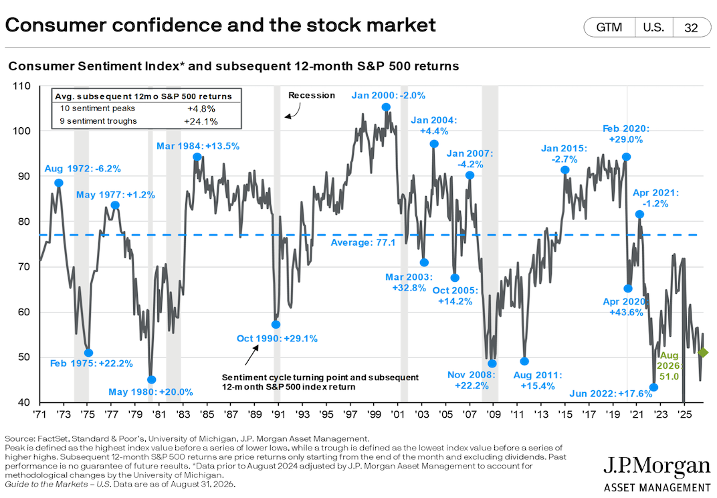
Consumer Confidence - I’m continually surprised how low the consumer confidence reading is almost as low as it was during the Financial Recession of 2008. Historically, when confidence is this low, market returns are favorable
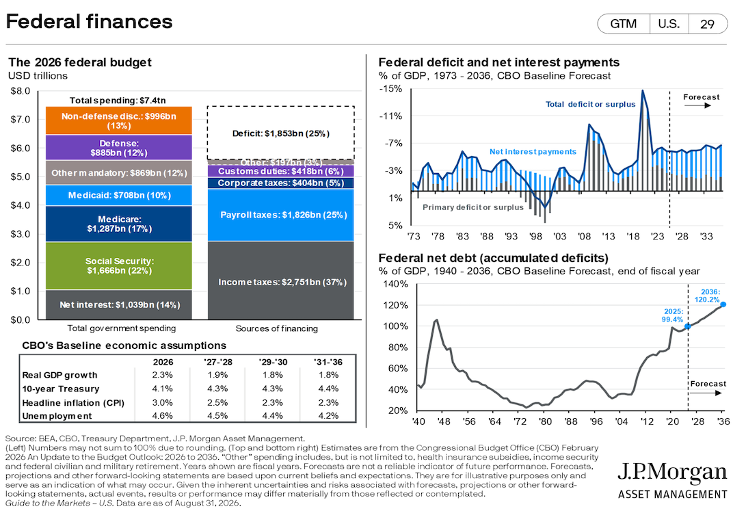
Debt Interest Payments – Most in this country would agree that the Federal Debt is just too high, but did you realize that the interest payments on this debt is now just over 1.2 trillion a year? What should we do about it? My guess is we should balance the government budget…. But no one is asking me.
In closing
We of course cannot control what the market does from here and we cannot predict when the next market downturn will occur. But we can control our behavior to these outside events and continue to stick with our long-term investment strategy.
As always, thank you for your trust, if you have any questions/concerns please contact me. If you found this useful, please share with someone you care about
-Dave
David Hobbs, CFP®
Wealth Advisor | Owner
Hobbs Wealth Management
Past performance may not be indicative of future results. Investing in securities involves risks, including the potential for loss of principal. There is no guarantee that any investment plan or strategy will be successful.
Standard & Poor’s 500 (S&P 500) - a market-cap weighted index composed of the common stocks of 500 leading companies in leading industries of the U.S. economy.
Russell 2000 – The index measures the performance of the small-cap segment of the US equity universe. It is a subset of the Russell 3000 and includes approximately 2000 of the smallest securities based on a combination of their market cap and current index membership.
MSCI ACWI ex USA – The index measures the performance of the large and mid-cap segments of the particular regions, excluding USA equity securities, including developed and emerging markets. It is free float-adjusted market-capitalization weighted.
Federal Funds Rate - refers to the target interest rate set by the Federal Open Market Committee (FOMC). This target is the rate at which commercial banks borrow and lend their excess reserves to each other overnight.
This report was prepared by Hobbs Wealth Management, a State registered investment adviser under the Investment Advisers Act of 1940. Registration as an investment adviser does not imply a certain level of skill or training. The oral and written communications of an adviser provide you with information about which you determine to hire or retain an adviser. Neither the information nor any opinion expressed it so be construed as solicitation to buy or sell a security of personalized investment, tax, or legal advice. For more information please visit: https://adviserinfo.sec.gov/ and search for our firm name.
This newsletter is prepared to provide a degree of insight into the analysis used by Hobbs Wealth Management to make investment decisions. It is not a complete description of all the factors used by Hobbs Wealth Management to make decisions on behalf of clients. The opinions included are not intended to be taken as fact but are Hobbs Wealth Management’s interpretation of the impact of external events on investments.
The information herein was obtained from various sources. Hobbs Wealth Management does not guarantee the accuracy or completeness of information provided by third parties. The information in this report is given as of the date indicated and is believed to be reliable. Hobbs Wealth Management assumes no obligation to update this information, or to advise on further developments relating to it.
This article contains external links directing you to a third-party website. Although we have reviewed the website prior to creating the link, we are not responsible for the content of the site.
An index is an unmanaged portfolio of specific securities, the performance of which is often used as a benchmark in judging the relative performance of certain asset classes. Investors cannot invest directly in an index. An index does not charge management fees or brokerage expenses, and no such fees or expenses were deducted from the performance shown.
The mention of specific securities and sectors illustrates the application of our investment approach only and is not to be considered a recommendation. The specific securities identified and described herein do not represent all of the securities purchased or sold for the portfolio, and it should not be assumed that investment in these securities was or will be profitable. There is no assurance that the securities purchased remain in the portfolio, or that securities sold have not been repurchased. For a complete list of holdings, please contact your portfolio advisor.
Hobbs Wealth Management may discuss and display charts, graphs, formulas, stock and sector picks which are not intended to be used by themselves to determine which securities to buy or sell, or when to buy or sell them. This specific information is limited and should not be used on their own to make investment decisions. This information is offered as educational only.